Qoute of the Day
Always bear in mind that your own resolution to succeed is more important than any other one thing. (Abraham Lincoln)
Friday, January 1, 2010

Thursday, December 31, 2009
Happy and Prosperous New Year 2010
Blame never Produces good result. Hot Temper, short live; cool temper, long live.
Wish all friends and readers "Happy and Prosperous New Year 2010.
Wish all friends and readers "Happy and Prosperous New Year 2010.
Wednesday, December 30, 2009
Thursday, September 17, 2009
Dear Friends,
It is our great pleasure to inform you Renal transplantation has been done to Miss May Thu Kyaw's body yesterday very successfully. She is in intensive care unit now. According to the doctors attending to her, she is doing well. Urine output is much more. Her mother, the potential donor, is also doing well. The donor will be discharged from Hospital on 18th Sept. Miss May Thu Kyaw will be kept in ICU for 3 or 4 days; after being stable she will be shifted to norma room, and she may also be discharged within next 7 to 8 days from hospital. We are very happy Miss May Thu Kyaw will lead a new life with all your Metta and contributions.
With thanks,
Ven. Dr. Nando Batha
It is our great pleasure to inform you Renal transplantation has been done to Miss May Thu Kyaw's body yesterday very successfully. She is in intensive care unit now. According to the doctors attending to her, she is doing well. Urine output is much more. Her mother, the potential donor, is also doing well. The donor will be discharged from Hospital on 18th Sept. Miss May Thu Kyaw will be kept in ICU for 3 or 4 days; after being stable she will be shifted to norma room, and she may also be discharged within next 7 to 8 days from hospital. We are very happy Miss May Thu Kyaw will lead a new life with all your Metta and contributions.
With thanks,
Ven. Dr. Nando Batha
Monday, September 14, 2009
Social Life is key to good health: Study
Group Membership Can Reduce Risk of Stroke, Dementia And Even Common Cold
Washington: The quality of social life has a greater impact on a person’s health and well – being than diet and exercise, according to a new study.
Researchers have found that quality of an individual’s social life significantly reduces the risk of condition like stroke, dementia and even the common cold. These findings have been validated by the universities of Exeter and Queensland, Australia, based on a review study of previous research, including their own, which links group membership with physical and mental health.
Lead researcher Alex Haslam, a professor at the University of Exeter said: “We are social animals who live and have evolved to live in social groups. Membership of groups, from football teams to book clubs and voluntary societies, gives us a sense of social identity. This is an indispensable part of who we are and what we need to be in order to lead rich and fulfilling lives. For this reason groups are central to mental functioning health and well-being.”
The researchers have based their findings on an analysis of a number of recent studies.
A 2008 study of stroke sufferers showed that being able to maintain valued group memberships placed an important role in positive recovery as an ability to overcome cognitive difficulties. After their stroke, people’s life satisfaction increased by 12 percent for every group membership.
Likewise, a 2009 study of residents entering a new care home showed that those who participated as a group in decisions related to the decoration of communal areas used those areas 57 percent more over the next month and were far happier as a result. In contrast, the use of space by residents in a control group declined by 60 percent.
Co-researcher Jolanda Jetten of the University of Queensland said: “New research shows just how important groups and social identity are to well-being. This is something that people often overlook in the rush to find medical solutions to problems associated with ageing. But it is time that these factors were taken much more seriously.”
The findings are published in the latest edition of the ‘Scientific American Mind’journal. AGENCIES
[THE TIMES OF INDIA, KOLKATA, MONDAY, SEPTEMBER 14, 2009]
Washington: The quality of social life has a greater impact on a person’s health and well – being than diet and exercise, according to a new study.
Researchers have found that quality of an individual’s social life significantly reduces the risk of condition like stroke, dementia and even the common cold. These findings have been validated by the universities of Exeter and Queensland, Australia, based on a review study of previous research, including their own, which links group membership with physical and mental health.
Lead researcher Alex Haslam, a professor at the University of Exeter said: “We are social animals who live and have evolved to live in social groups. Membership of groups, from football teams to book clubs and voluntary societies, gives us a sense of social identity. This is an indispensable part of who we are and what we need to be in order to lead rich and fulfilling lives. For this reason groups are central to mental functioning health and well-being.”
The researchers have based their findings on an analysis of a number of recent studies.
A 2008 study of stroke sufferers showed that being able to maintain valued group memberships placed an important role in positive recovery as an ability to overcome cognitive difficulties. After their stroke, people’s life satisfaction increased by 12 percent for every group membership.
Likewise, a 2009 study of residents entering a new care home showed that those who participated as a group in decisions related to the decoration of communal areas used those areas 57 percent more over the next month and were far happier as a result. In contrast, the use of space by residents in a control group declined by 60 percent.
Co-researcher Jolanda Jetten of the University of Queensland said: “New research shows just how important groups and social identity are to well-being. This is something that people often overlook in the rush to find medical solutions to problems associated with ageing. But it is time that these factors were taken much more seriously.”
The findings are published in the latest edition of the ‘Scientific American Mind’journal. AGENCIES
[THE TIMES OF INDIA, KOLKATA, MONDAY, SEPTEMBER 14, 2009]
Saturday, September 12, 2009
Eight Clues to Happiness

Eight clues to happiness
Having lived a reasonably contented life, I was musing over what a person should strive for to achieve happiness. I drew up a list of a few essentials which I put forward for the readers' appraisal.
First and foremost is good health. If you do not enjoy good health you can never be happy. Any ailment, however trivial, will deduct from your happiness.
Second, a healthy bank balance. It need not run into crores but should be enough to provide for creature comforts and something to spare for recreation, like eating out, going to pictures, travelling or going on holidays on the hills or by the sea. Shortage of money can be only demoralizing. Living on credit or borrowing is demeaning and lowers one in one's own eyes.
Third, a home of your own. Rented premises can never give you the snug feeling of a nest which is yours for keeps that a home provides: if it has a garden space, all the better. Plant your own trees and flowers, see them grow and blossom, cultivate a sense of kinship with them.
Fourth, an understanding companion, be it your spouse or a friend. If there are too many misunderstandings, they will rob you of your peace of mind. It is better to be divorced than to bicker all the time.
Fifth, lack of envy towards those who have done better than you in life – risen higher, made more money, or earned more fame. Envy can be very corroding; avoid comparing yourself with others.
Sixth, do not allow other people to descend on you for gup-shup. By the time you get rid of them, you will feel exhausted and poisoned by their gossip-mongering.
Seventh, Cultivate some hobbies which can bring you a sense of fulfillment, such as gardening, reading, writing, painting, playing or listening to music. Going to clubs or parties to get free drinks or to meet celebrities is criminal waste of time.
Eighth, every morning and evening, devote 15 minutes to introspection. In the morning, 10 minutes should be spent on stilling the mind and then five in listing things you have to do that day. In the evening, five minutes to still the mind again, and ten to go over what you had undertaken to do.
Nathaniel Cotton (1721-1788) summed up my views on the subject in one verse: If solid happiness we prize,/ Within our breast this jewel lies;/ and they are fools who roam:/ The world has nothing to bestow;/ From our own selves our joys must flow/ And that dear hut, - our home.
[Khushwant Singh]
[The Telegraph, Saturday 12 September 09]
Sunday, September 6, 2009
List of Donors for saving Miss. May Thu Kyaw's life
Dear Friends,
Donation drive has been made to save Miss. May Thu Kyaw's life. Great thanks for all who contribute something. Nothing is small in donation. We expect within this week more donors will come forward for this noble cause. Here is the list of donors given below.
1) Ken & Visakha Kawasaki, BRM, Kandy, Sri Lanka USD $ 100/=
2) Russa Road Young Buddhist Student Literacy Mission,
Kathor, Badu, Barasat, Kolkata, W.B., India. USD $ 1000/=
3) Mr. Ko Ko Gyi, Yangon, Myanmar Rs. 1500/=
4) Ma Thidar Soe Aung, Yangon, Myanmar Rs. 1500/=
5) Mr. Phillip Barua, Kolkata, India. Rs. 1000/=
6) Mr. S. Nath Das, Barasat, Kolkata, India. Rs. 2000/=
Dear Friends,
Donation drive has been made to save Miss. May Thu Kyaw's life. Great thanks for all who contribute something. Nothing is small in donation. We expect within this week more donors will come forward for this noble cause. Here is the list of donors given below.
1) Ken & Visakha Kawasaki, BRM, Kandy, Sri Lanka USD $ 100/=
2) Russa Road Young Buddhist Student Literacy Mission,
Kathor, Badu, Barasat, Kolkata, W.B., India. USD $ 1000/=
3) Mr. Ko Ko Gyi, Yangon, Myanmar Rs. 1500/=
4) Ma Thidar Soe Aung, Yangon, Myanmar Rs. 1500/=
5) Mr. Phillip Barua, Kolkata, India. Rs. 1000/=
6) Mr. S. Nath Das, Barasat, Kolkata, India. Rs. 2000/=
7) U San Maung and friends, South Korea. USD 500/=
8) Teachers and students of Bodhisukha School, Kolkata. Rs. 13400/=
9) Moe Moe Kyi, Yangon. Rs. 1000/=
10) Ma Soe Soe Myint, Yangon. Rs. 1000/=
Dear Friends,
It is our pleasure to inform you that we have been trying to raise fund for partial treatment cost for Miss May Thu Kyaw. It is great news that Mrs. Sein Tha Aung (a) Sankaria Sanyal, the principal of Bodhisukha School has given her conscent that she will undertake all treatment cost for the patient. Parents will have to return the amount taken from her within three months without any interest. We are very happy to manage the fund in this way. So let us hope all the best for Miss May Thu Kyaw, who will be admitted to hospital on 14th September 09 and Kidney transplantation will be taken place on 16th Sept.
9) Moe Moe Kyi, Yangon. Rs. 1000/=
10) Ma Soe Soe Myint, Yangon. Rs. 1000/=
Dear Friends,
It is our pleasure to inform you that we have been trying to raise fund for partial treatment cost for Miss May Thu Kyaw. It is great news that Mrs. Sein Tha Aung (a) Sankaria Sanyal, the principal of Bodhisukha School has given her conscent that she will undertake all treatment cost for the patient. Parents will have to return the amount taken from her within three months without any interest. We are very happy to manage the fund in this way. So let us hope all the best for Miss May Thu Kyaw, who will be admitted to hospital on 14th September 09 and Kidney transplantation will be taken place on 16th Sept.
Wednesday, September 2, 2009
Urgent Assistance needed to Save Miss. May Thu Kyaw

 Urgent assistance needed to Save Ms. May Thu Kyaw
Dear friends,
Russa Road Young Buddhist Student Literacy Mission is giving health care services to the patients especially coming from Burma and Bangladesh. Our services include interpretation, co-ordination between patients and doctors, helping for completion of all formalities to get permission from Health Department, Government of West Bengal, in case of organ transplants with unrelated donors etc. For the last two years the Mission has been giving all these services. More than 60 patients, mostly with kidney failure diseases, from Burma got better treatment here at Apollo Gleneagles Hospitals, Kolkata, with our Health Help Services. Now all of them are leading their normal lives. Apollo Gleneagles Hospitals, Kolkata, is the only hospital, which has JCI certificate in eastern India.
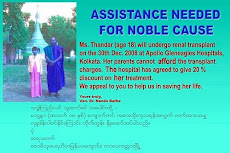
Ms. May Thu Kyaw, aged 11, with kidney failure disease, arrived here at our Mission along with her parents on 20/07/09. Earlier she was treated at Child General Hospital in Yangon for 8 months, but the condition was deteriorating day by day. According to her parents if they were late to reach India for two weeks more, then their daughter may be no more alive, because all medical facilities are not available there. Immediately her arriving in India, we took her to Nephrologist, who advised to get her admitted in Hospital. Accordingly we got her admitted the next day on 21/07/09. After being stable in all sides, doctors tried to make neckline on her neck, through which only dialysis can be done safely. Unfortunately it was not successful, and then the doctors took an alternate option to do from the vein at thigh. After being successful this time, she was doing well and discharged from hospital, and waiting for completion of all formalities to be done. While preparing for renal transplant, which will take place after 3 days, she became senseless with high blood pressure. Got admitted to hospital again, she was kept in ICU for three days. Now doctors are trying again to put neckline on her neck. After neckline done successfully, she needs to kidney transplant, which will take place on 14th September, 2009. The potential donor is her mother, Daw Htay Htay Kyi. During these two times hospitalizations before actual kidney transplant done, all money, the parents have brought, has gone. Her father, Ko Ko Naing, is a bus driver by profession, having very low income. They came here getting helps from friend's circles. Huge amount of expenditures already incurred while eight months hospitalization in Yangon. Now their friend's circles also cannot support any more.
Now I would like to appeal to you to save her life. She is only 11 years old. Saving her life depends on your kind and generous donation. According to kidney package expenditure, she will need $ 10000/-. This Mission has sanctioned $ 1000/. The amount left with parents is $ 2500/-. So we are in urgent need $ 6500/- more. Kindly come forward to save her. All money transaction will be done through bank. Bank statement will be sent to each and every donor.
Russa Road Young Buddhist Student Literacy Mission is giving health care services to the patients especially coming from Burma and Bangladesh. Our services include interpretation, co-ordination between patients and doctors, helping for completion of all formalities to get permission from Health Department, Government of West Bengal, in case of organ transplants with unrelated donors etc. For the last two years the Mission has been giving all these services. More than 60 patients, mostly with kidney failure diseases, from Burma got better treatment here at Apollo Gleneagles Hospitals, Kolkata, with our Health Help Services. Now all of them are leading their normal lives. Apollo Gleneagles Hospitals, Kolkata, is the only hospital, which has JCI certificate in eastern India.
Ms. May Thu Kyaw, aged 11, with kidney failure disease, arrived here at our Mission along with her parents on 20/07/09. Earlier she was treated at Child General Hospital in Yangon for 8 months, but the condition was deteriorating day by day. According to her parents if they were late to reach India for two weeks more, then their daughter may be no more alive, because all medical facilities are not available there. Immediately her arriving in India, we took her to Nephrologist, who advised to get her admitted in Hospital. Accordingly we got her admitted the next day on 21/07/09. After being stable in all sides, doctors tried to make neckline on her neck, through which only dialysis can be done safely. Unfortunately it was not successful, and then the doctors took an alternate option to do from the vein at thigh. After being successful this time, she was doing well and discharged from hospital, and waiting for completion of all formalities to be done. While preparing for renal transplant, which will take place after 3 days, she became senseless with high blood pressure. Got admitted to hospital again, she was kept in ICU for three days. Now doctors are trying again to put neckline on her neck. After neckline done successfully, she needs to kidney transplant, which will take place on 14th September, 2009. The potential donor is her mother, Daw Htay Htay Kyi. During these two times hospitalizations before actual kidney transplant done, all money, the parents have brought, has gone. Her father, Ko Ko Naing, is a bus driver by profession, having very low income. They came here getting helps from friend's circles. Huge amount of expenditures already incurred while eight months hospitalization in Yangon. Now their friend's circles also cannot support any more.
Now I would like to appeal to you to save her life. She is only 11 years old. Saving her life depends on your kind and generous donation. According to kidney package expenditure, she will need $ 10000/-. This Mission has sanctioned $ 1000/. The amount left with parents is $ 2500/-. So we are in urgent need $ 6500/- more. Kindly come forward to save her. All money transaction will be done through bank. Bank statement will be sent to each and every donor.
Kindly send your kind donation to :
Instruction for Remittance in US Dollars for Savings Account:
Transaction Reference No. :
To : :JP Morgan Chase Bank
N.Y, USA
SWIFT – CHASUS33
ABA – 021000021
For Credit to : 001-1-407376 CHIPS UID 340191
AXIS Bank Ltd., Mumbai
For Further credit to : AXIS Bank Ltd.
Kolkata Main Branch
SWIFT – UTIBINBB005
Ultimate Beneficiary : Name: Russa Road Young Buddhist Student Literacy Mission,
S.B. A/C No. 021010100009202
For further information please contact to : ndbatha@gmail.com
Tuesday, August 25, 2009
Bodhisukha School

Background
Russa Road Young Buddhist Student Literacy Mission was established in 1995 and duly registered under the Society Registration Act. XXVI of 1961 of West Bengal on 31/10/95, and also registered under the Foreign Contribution (Regulation) Act of Government of India on 30/6/2000, for the purpose of creating a new age in which the human family can live in peace and dignity.
The Mission was established by socially minded Buddhist monks, who came to India to enrich their knowledge at different universities. Since its inception, the Mission started to launch Education Program by giving stipend to needy students pursuing higher studies at Nava Nalanda Mahavihara, Magadh University and other institutions. Later it developed as the "Mark Decker Scholarship Program". The Program was sponsored by Buddhist Relief Mission (BRM) of Japan. The BRM is still continuing its funding to this program of the Mission.
Bodhisukha School
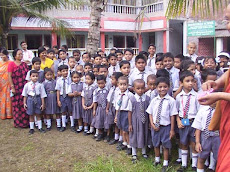
Ever since its inception the Mission paid special attention to promote human validity through literary, educational and other programs. As an implementing of its main objectives "Bodhisukha School" was established in 2001 by the Mission with initial donation from Buddhist Relief Mission (BRM) of Japan. BRM has donated the cost of dormitory building and the cost of school running for three consecutive years. The school started with 15 hostel students and 4 teachers. In the beginning it was only for the hostel students. But after two years later the school committee decided to take admission for day-students, too, from surrounding areas. The school is totally English Medium. The classes are from Nursery to Class VIII. The number of student is increasing day by day. At present 180 students areEnrolling in different classes. In coming new session (2009-2010) we expect more than two hundred students from the local surrounding area. It becomes very necessary to expand the school building. Accordingly the school management committee has decided to avail loan from State Bank of India. After satisfying the authorities of the said bank has sanctioned a loan amounting to Rs. 27.95 lacs on 26/3/07.
Objectives of the project are 1) to give education to poor
children, 2) to emerge the children as respectable citizens of the world. Venerable
Dr. Nando Batha, vice president of the Mission, is the authorized person to carry out
the project. By completion of this project, many children from surrounding area aswell as remote area will get benefit.
Beneficiaries
Beneficiaries are mostly from local area as well as remote area of north-eastern states of India such as Tripura, Assam etc. Beneficiaries will also be from Burma and Bangladesh as boarding students. However, the students from Burma and Bangladesh will be accepted only after the school is affiliated to CBSE (Central Board of Secondary Education, Govt of India). Without affiliation the govt. of India will not issue student visa. The Mission has already applied for School Affiliation to CBSE.
Construction of School Building
According to Engineer's estimated report total cost for three storeys school building will be Rupees 1,02,30,637.00 ( Rupees one crore two lac thirty thousand six hundred and thirty seven only) ( US $ 2,31,882.07 more or less).
After availing the said loan the Mission started construction immediately. Comparing to the cost estimate, the sanctioned loan is very small. However, the Mission has completed 30 % of construction with donors' contribution. The school is also expected to get 2nd loan from the said bank after affiliating to CBSE board, New Delhi.
Annual Sports and Events
Every year the School conducts Annual sports and Annual excursion programs, in which every child can perform their ability. Children are encouraged a lot by doing these programs. They can learn many new things. We believe that the school is not only to impart education, but also to encourage their inner energy how to utilize. Sometimes the school also conducts tour to national important places. Like many other famous schools, the Bodhisukha School also observes many events such as children day, teacher's day, Buddha Purnima, Rabindra Jayanti, etc.
The Mission was established by socially minded Buddhist monks, who came to India to enrich their knowledge at different universities. Since its inception, the Mission started to launch Education Program by giving stipend to needy students pursuing higher studies at Nava Nalanda Mahavihara, Magadh University and other institutions. Later it developed as the "Mark Decker Scholarship Program". The Program was sponsored by Buddhist Relief Mission (BRM) of Japan. The BRM is still continuing its funding to this program of the Mission.
Bodhisukha School
Ever since its inception the Mission paid special attention to promote human validity through literary, educational and other programs. As an implementing of its main objectives "Bodhisukha School" was established in 2001 by the Mission with initial donation from Buddhist Relief Mission (BRM) of Japan. BRM has donated the cost of dormitory building and the cost of school running for three consecutive years. The school started with 15 hostel students and 4 teachers. In the beginning it was only for the hostel students. But after two years later the school committee decided to take admission for day-students, too, from surrounding areas. The school is totally English Medium. The classes are from Nursery to Class VIII. The number of student is increasing day by day. At present 180 students areEnrolling in different classes. In coming new session (2009-2010) we expect more than two hundred students from the local surrounding area. It becomes very necessary to expand the school building. Accordingly the school management committee has decided to avail loan from State Bank of India. After satisfying the authorities of the said bank has sanctioned a loan amounting to Rs. 27.95 lacs on 26/3/07.
Objectives of the project are 1) to give education to poor
children, 2) to emerge the children as respectable citizens of the world. Venerable
Dr. Nando Batha, vice president of the Mission, is the authorized person to carry out
the project. By completion of this project, many children from surrounding area aswell as remote area will get benefit.
Beneficiaries
Beneficiaries are mostly from local area as well as remote area of north-eastern states of India such as Tripura, Assam etc. Beneficiaries will also be from Burma and Bangladesh as boarding students. However, the students from Burma and Bangladesh will be accepted only after the school is affiliated to CBSE (Central Board of Secondary Education, Govt of India). Without affiliation the govt. of India will not issue student visa. The Mission has already applied for School Affiliation to CBSE.
Construction of School Building
According to Engineer's estimated report total cost for three storeys school building will be Rupees 1,02,30,637.00 ( Rupees one crore two lac thirty thousand six hundred and thirty seven only) ( US $ 2,31,882.07 more or less).
After availing the said loan the Mission started construction immediately. Comparing to the cost estimate, the sanctioned loan is very small. However, the Mission has completed 30 % of construction with donors' contribution. The school is also expected to get 2nd loan from the said bank after affiliating to CBSE board, New Delhi.
Annual Sports and Events
Every year the School conducts Annual sports and Annual excursion programs, in which every child can perform their ability. Children are encouraged a lot by doing these programs. They can learn many new things. We believe that the school is not only to impart education, but also to encourage their inner energy how to utilize. Sometimes the school also conducts tour to national important places. Like many other famous schools, the Bodhisukha School also observes many events such as children day, teacher's day, Buddha Purnima, Rabindra Jayanti, etc.
Saturday, August 22, 2009
Health Care Service

Health Care Service
Arogya Prama Labha - Health is the greatest wealth. Without sound health we cannot do any work; we cannot enjoy our life. Health Care, therefore, is very important. Health care is a part of human validity. There are thousands of people dying every day without this validity. Thousands of women and children are dying every second due to lack of Health Care facility and Health awareness. If Health care and awareness facilities are available, they would have been living longer lives.
We believe Prevention is better than Cure. For prevention from all diseases the only way is to make general people aware of Health hazardous.
Recently we, Young Buddhist Student Literacy Mission, have tied-up with Apollo Gleneagles Hospitals, Kolkata, for proper Health Care Services. Many Kidney, Heart and Cancer patients came to Kolkata for their better treatment. More than 60 patients are now leading their normal lives after quality treatment done here. Apollo Gleneagles Hospitals, Kolkata, is the only hospital having JCI certificate in Eastern India.
Very recently U Thein Han has gone back to Myanmar after successful kidney transplantation here. The donor is his young sister Daw Mya Mya Thein.
[From right to left: Mya Mya Thein (kidney donor), U Thein Han, Ven. Dr. Nando Batha, U Ko Ko Gyi, (young brother of U Thein Han), and Daw Htay Kyi, another young sister of U Thein Han]
We believe Prevention is better than Cure. For prevention from all diseases the only way is to make general people aware of Health hazardous.
Recently we, Young Buddhist Student Literacy Mission, have tied-up with Apollo Gleneagles Hospitals, Kolkata, for proper Health Care Services. Many Kidney, Heart and Cancer patients came to Kolkata for their better treatment. More than 60 patients are now leading their normal lives after quality treatment done here. Apollo Gleneagles Hospitals, Kolkata, is the only hospital having JCI certificate in Eastern India.
Very recently U Thein Han has gone back to Myanmar after successful kidney transplantation here. The donor is his young sister Daw Mya Mya Thein.
[From right to left: Mya Mya Thein (kidney donor), U Thein Han, Ven. Dr. Nando Batha, U Ko Ko Gyi, (young brother of U Thein Han), and Daw Htay Kyi, another young sister of U Thein Han]
Sunday, November 25, 2007
English Training Course

Intensive English Training Course
Bodhisukha Parahita Temple is going to organize "Special English Proficiency Training Course" on and from 15th March to 14th April 08, free of charge. Last two years the temple lunched this course very successfully. Resource persons are coming from USA. Many students got benefits from this course. The organizers are expecting this year more monk-students will participate in the course. It is our great pleasure to invite all students studying at different universities in India. It is great opportunity for those who are interested in enriching their knowledge. Bodhisukha Parahita Temple is going to organize "Special English Proficiency Training Course" on and from 15th March to 14th April 08, free of charge. Last two years the temple lunched this course very successfully. Resource persons are coming from USA. Many students got benefits from this course. The organizers are expecting this year more monk-students will participate in the course. It is our great pleasure to invite all students studying at different universities in India. It is great opportunity for those who are interested in enriching their knowledge.
Buddhism and AIDS
How religion has assisted people living with HiV/AIDS
Honorable Consul General, respected ladies and gentle men; I am very happy to be with you here, and I am very much grateful to Mr. Rafique Anwar, Program Manager, and all organisers of this meeting who have invited me to be here. I am Nando Batha, representing Russa Road Young Buddhist Student Literacy Mission, having its head Office at Barasat.
Regarding "how religion has assisted people living with HIV/AIDS, I would like to express my view here, especially how Buddhist religion offers help to those suffering from HIV/AIDS. It is no doubt religion has assisted people in many ways. Religion has assisted the people not only living with HIV/AIDS, but also living with many depressions. Now-a-day our lives become so stressful, because of heavy work pressure, because of environmental and social problems and so on. We have to try so hard to survive in this world. Science still cannot give any answer to meet all these challenges posted in front of our human society. Religion may be the only one which can solve all sort of problems.
According to Buddhism, death is definitely not a subject to be avoided. Instead it is the key to unlocking the apparent mystery of life. Siddhartha Gautama renounced his comfortable princely life to seek the end of suffering, not just for himself, but for all. We are encouraged to consider old age, sickness, and death, not in general terms, but in a very personal way, mentally reciting this daily reflection: I am of the nature to age. I have not got beyond aging. I am of the nature to sicken. I have not got beyond illness. I am of the nature to die. I have not got beyond death. I will be separated from everyone and everything that is dear to me.
I am born of my kamma, heir of my kamma, abide supported by my kamma and of that which I do, of that I will be the heir.
AIDS is a true pandemic, with a cure still a long way off, and its prognosis, sooner or later, death. In that sense, AIDS has been called the “illness of all illnesses.” Still, the thoughtful Buddhist sees that we are all under a sentence of death. Death, by illness, by accident, or by another’s hand, comes inevitably along with birth. Thus, AIDS is still just another graphic proof of the suffering intrinsic to existence. If the Buddha’s lesson is wisely applied, the person with AIDS, as well as the rest of us, can contemplate death, thus weakening its threat and finding comfort, strength, and support in understanding what AIDS and death really mean. Essentially, AIDS is no different from tsunamis and earthquakes. Like all other phenomena and other diseases, AIDS develops only within the complex and natural set of causes and conditions. Thus Buddhism offers to those with HIV/AIDS, acceptance and compassion without discrimination.
Buddhism wholeheartedly agrees with the principles of the Universal Declaration of Human Rights, as formulated in article 25, paragraph 1:
“Everyone has the right to a standard of living adequate for the health and well-being of himself and of his family, including … medical care and necessary social services, and the right to security in the event of … sickness … .
According to Buddhism Kamma, also called the Law of Cause and Effect, determines why one succumbs to infection, while another does not. Under the law of Kamma, each person gets what he has created for himself. Each one's life, with its particular share of joys and sorrows, is neither more nor less than the result of his own past actions, good and bad. Each person is the architect of his own fortune. In kamma, we find the root cause of death. We also know that no arbitrary power fashions this kamma according to its will or caprice. It is the result of our own actions. As we sow, so shall we reap. We must understand, though, that kamma is not something generated in the “closed box” of the past. It is always in the making. By our words and deeds, at every moment, we are contributing to it. Hence, the future is not conditioned only by the past. It is constantly being conditioned by the present. This is the great optimism of the Buddha’s teaching. In a sense, we are all of us under a sentence of death, but an HIV/AIDS diagnosis means that the patient can’t pretend otherwise, can’t delude himself with the illusion of immortality. How a person reacts, though, creates the conditions for his future. If we fear our death sentence, we should understand that all other living things instinctively react as we do as well. Reflecting on our fears, it should naturally follow that we develop compassion for others, because we are in the same situation. Meditating on death means that we reflect that it is the common lot of all living things. Furthermore, if we reflect sufficiently on death, we should feel the urgent need to make wise use of the present, so as to ensure a happy future. Buddha talked about this urgency “as if one’s turban were on fire!” Certainly if the turban wrapped around your head were flaming, you wouldn’t be daydreaming or wasting time! Our religion gives us useful tools to face living and dying. We know that the person who leads a virtuous life, harming none, living open-handed, being generous and compassionate, helping whom he can, living in conformity with the Dhamma, and always remembering the Dhamma, is without doubt laying the foundation of a happy future life. Dhammo have rakkhati dhamma carim The Dhamma most assuredly protects him who lives in harmony with it. Such harmony is encouraged by the contemplation of death. The fear of death subsides for one who knows that he is doing good and avoiding evil.
Buddha gave us a number of techniques for purifying our minds. For someone who has been diagnosed HIV positive, one of the most useful is to practice loving-kindness, or metta. The HIV/AIDS patient may, at first, feel great shock, or even anger, but metta meditation begins by being kind and friendly to oneself. In metta meditation, we must begin by wishing that we ourselves be well, free from anger and hatred, free from greed and envy, free from fear and grief, free from disease and pain. We pervade ourselves with peacefulness. This practice means no reproaches, no pernicious self-hate, no painful what-ifs. We must wish ourselves happiness now, suffusing ourselves with calm and well-being. When we have succeeded in being kind to ourselves, we proceed to spreading friendliness and loving-kindness to those close to us, then to those who are strangers, and finally to those who may wish us ill. Metta is beneficial to all of us and may be especially useful to someone dealing with AIDS. Greater meditation leads to an increase in wisdom. Thus, bad can be changed into good. A careless, or even a cruel, person can become a mindful and good person. One who is good is always happy. He has no fear of death because he has no fear of the life beyond. The powerful changes that good deeds and meditation bring about in this life will also ensure, after death, the rebirth of a more fortunate being. This means that the person who has practiced diligently can face a good death, without fear, confident in a good next birth. Buddha taught us to meditate on death, carefully and systematically, in order to weaken our infatuation with sense-pleasures, to reduce our vanity, and to give us perspective. We should all reflect that "death will take place," “death will come to me,” lest we be heedless. Mindfulness of death purifies and refines the mind. It also can rob death of its terror. It will help, at that moment when one is gasping for the last breath, to face that situation with courage. Contemplating death relieves fear. It teaches us to live with proper values, and it enables us to die a good death with fortitude and calm,
Thus Religion has assisted people living with HIV/AIDS, and Religion will continue to help the people living with HIV/AIDS in the century that will follow.
Thank you all so much.
(The paper presented and read out at The American Information Resource Center, Calcutta, on 29/12/05 by Ven. Dr. Nando Batha, Vice President, Russa Road Young Buddhist Student Literacy Mission, P.O. Badu, P.S. Barasat, 24 Parganas (N), Kolkata 700128, West Bengal, India. The title of program is "The role of religious leaders and faith-based organizations in the fight against HIV/AIDS"))
Subscribe to:
Posts (Atom)